
A few quiet minutes can change the tone of an entire day, but only when those minutes have a meaningful container. Guided meditation programs offer that container: a caring voice, an intentional practice, and a rhythm you can return to when life feels noisy, demanding, or disconnected from what matters most.
For many people, meditation begins with a sincere desire for peace and ends after a few restless attempts to sit still. That is not a personal failure. The mind has been trained to plan, remember, solve, and react. A guided practice gives the mind a gentle place to rest its attention while the body learns that slowing down can feel safe, nourishing, and deeply alive.
What Guided Meditation Programs Can Offer
A meditation program is more than a collection of recordings. At its best, it is a progressive experience that helps you build trust in your own inner knowing. One practice may focus on breath, another on releasing tension from the body, and another on opening the heart through compassion, mantra, or gratitude. Over time, these experiences become familiar pathways back to your center.
This structure matters. Choosing a meditation from an endless library can feel surprisingly overwhelming when you are already stressed. A thoughtfully designed program removes some of that decision-making. You know what to practice today, how long to stay with it, and what intention is guiding the experience.
For someone new to meditation, this can make the practice approachable instead of mysterious. For a longtime yoga student, it can provide fresh depth and consistency. Even teachers and caregivers, who so often hold space for others, may find renewal in being guided themselves.
There is also a beautiful difference between simply trying to relax and practicing with purpose. Relaxation may be one welcome result, but meditation can also support clearer boundaries, a more compassionate response to difficult emotions, a stronger connection to intuition, and a greater ability to meet change without losing your grounding.
Choosing Guided Meditation Programs That Feel True to You
The right program depends on what you need in this season of life. A short breath-centered practice may be ideal for a busy professional who wants to begin the morning with clarity. Someone moving through grief, burnout, or a major life transition may benefit from a longer, gentler series with reflection, restorative movement, and heart-opening meditations.
Start by considering the teacher. A calming voice is helpful, but presence matters more. Look for a guide whose approach feels grounded, compassionate, and experienced. You should feel invited rather than pressured. Spiritual practice is not about performing serenity or forcing an experience. It is about meeting yourself honestly and allowing transformation to unfold in its own time.
Consider the style of meditation as well. Breath awareness can create steadiness. Body scans may help you reconnect with physical sensations after long periods of stress. Mantra meditation, a foundational element in Kundalini yoga, uses sacred sound and repetition to focus the mind and elevate the inner state. Visualization can be supportive when you are calling in healing, confidence, or a new direction.
Sound-based meditation offers another powerful doorway. The resonance of crystal bowls, gongs, or intentional music can help some people settle beyond mental chatter more quickly than silence alone. Yet silence has its own medicine. If sound feels overstimulating, a simple guided breath practice may serve you better. There is no single method that is best for everyone.
Length is another practical consideration. A program with 10-minute sessions is easier to sustain during a full week than an ambitious daily hour, especially at the beginning. That does not mean longer practices are less valuable. They can be profoundly restorative when you have the space. The wiser question is: What can you return to with devotion, not guilt?
Seek progression, not perfection
A meaningful program has an arc. It may begin by helping you establish a simple seat and breath, then gradually introduce deeper concentration, self-inquiry, or meditative movement. This progression allows the nervous system and attention to develop at a humane pace.
Be wary of promises that imply meditation will erase every challenge. A genuine practice does not remove the human experience. It helps you become more present within it. Some sessions will feel spacious and luminous. Others may reveal restlessness, sadness, impatience, or fatigue. These moments are not signs that meditation is failing. They are often signs that you are finally listening.
Creating a Practice That Stays With You
Consistency grows from kindness. Rather than waiting for the perfect morning, choose one realistic point in your day: before checking messages, after your walk, during a lunch break, or before sleep. Keep your meditation cushion, chair, or blanket ready so the invitation is visible.
It can help to create a small sacred space, even if it is only one corner of a room. A candle, a meaningful image, a journal, or a crystal bowl can signal to the body that this is a time to come home to yourself. The objects are not the practice, but they can support intention.
Approach the first few weeks as an experiment. Notice how you feel before and after each session. Are you sleeping more peacefully? Do you pause before reacting? Are you more aware of when your body needs rest? The changes may be subtle at first, but subtle changes often create the most enduring shift.
If you miss a day, begin again the next day without making it a story about discipline. Meditation is a relationship, not a streak to protect. Each return strengthens the relationship.
For couples, practicing together can create a shared moment of quiet that is rare in ordinary routines. You do not need to have identical experiences for the practice to be meaningful. Sitting side by side, breathing together, and allowing a few minutes of silence can soften the pace of the day and make room for deeper listening.
When a Retreat Deepens the Practice
Home practice gives meditation roots. Retreat gives it room to expand. Stepping away from familiar responsibilities, meals to prepare, and constant screens can reveal how much inner spaciousness has been waiting beneath the surface.
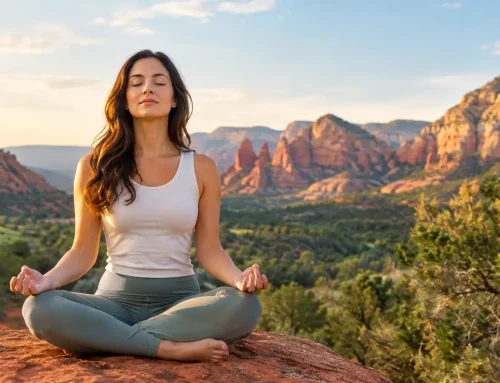
A well-held retreat combines guided meditation with yoga, breathwork, nourishing food, sacred ceremony, nature, and supportive community. In places such as Kauai, the Big Island, Sedona, or Greece, the natural landscape can become part of the teaching. Ocean waves, desert stillness, and wide open skies invite a quality of attention that cannot always be found in a hurried schedule.
The setting alone is not what creates transformation. It is the combination of an intentional environment, skillful guidance, and your willingness to arrive fully. Some guests come seeking rest. Others arrive at a crossroads, ready to reconnect with purpose, heal an old pattern, or rediscover joy. Both are welcome.
Yoga Inspirations approaches these experiences as sacred travel rather than a getaway from life. The practices are meant to travel home with you. A mantra you learn in a morning meditation, a breath practice that settles your nerves, or the memory of being deeply seen in community can continue to support your daily life long after the journey ends.
Let the Practice Meet the Real You
You do not need a perfectly quiet mind to begin. You do not need special clothing, a flawless schedule, or years of yoga experience. You only need a willingness to pause and let yourself be guided toward the part of you that already knows how to breathe, feel, receive, and begin again.
Choose a program that honors where you are, then give it enough time to become familiar. Let each practice be a small act of devotion to your well-being. The calm you seek may not arrive as a dramatic moment. It may quietly become the way you speak to yourself, the way you move through uncertainty, and the way you remember that your life is sacred.






Leave A Comment